


Economic Cost
The math doesn't add up.
$210 million for 2km? No real solution and full of problems!

What the City Plans To Do
The City is proposing to spend $210 million plus—roughly 7.5% of Kelowna's entire 10-year transportation budget—to build a mere 2 km stretch of road.
-
It is inefficient and expensive: That is more than twice the cost per kilometre compared to other road projects in our city.
-
It is not a solution: Even with this massive investment, it will likely fail to fix traffic congestion.
Think about it: If you drive from the bridge to Highway 33 today, you still have to turn left and cross downtown before reaching the new "bypass." Enterprise Way already bypasses the highway, yet it remains jammed with traffic. Adding more pavement does not solve the problem.
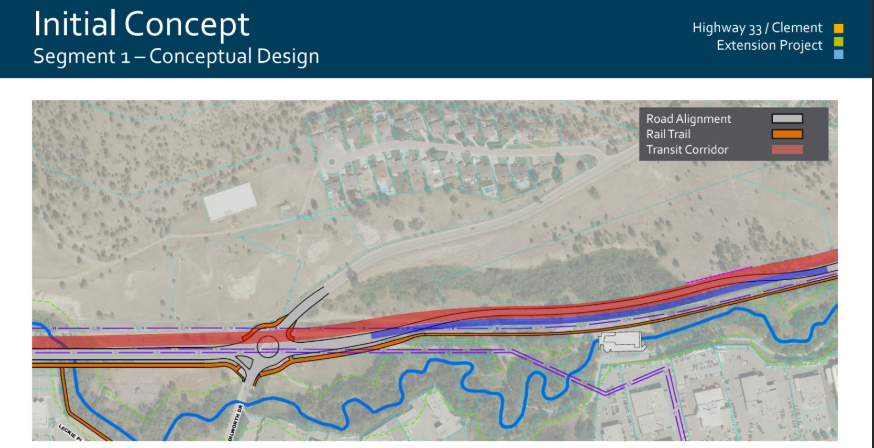
Images of the plan for the new road.
-
(A) sketch showing the approximate route from Spall to Highway 33
-
(B) cross-section showing retaining wall, two lanes of traffic, green strip, rail trail, sidewalk
Note that the road is wider near the roundabouts (up to 5 lanes), then narrows down to 2 lanes between these intersections.

Better Alternatives
We believe the $210 million could be more effectively allocated toward solutions that align with Kelowna's climate goals and commitments to biking, walking, and active transportation. Investing in these areas will directly support building a healthier and more sustainable city.
Expanded Bike Network
Public Transit
Light Rail
Why is it so expensive?
-
Infrastructure Conflicts: The route runs through a narrow corridor packed with gas pipelines, power lines, and a substation, making construction expensive and risky.
-
Engineering Nightmares: Engineers are planning 400 meters of retaining walls, some up to 16 meters high.
-
Environmental Threats: The land suffers from unstable soil, a high water table, and potential contamination from old industrial sites, requiring costly cleanup.